

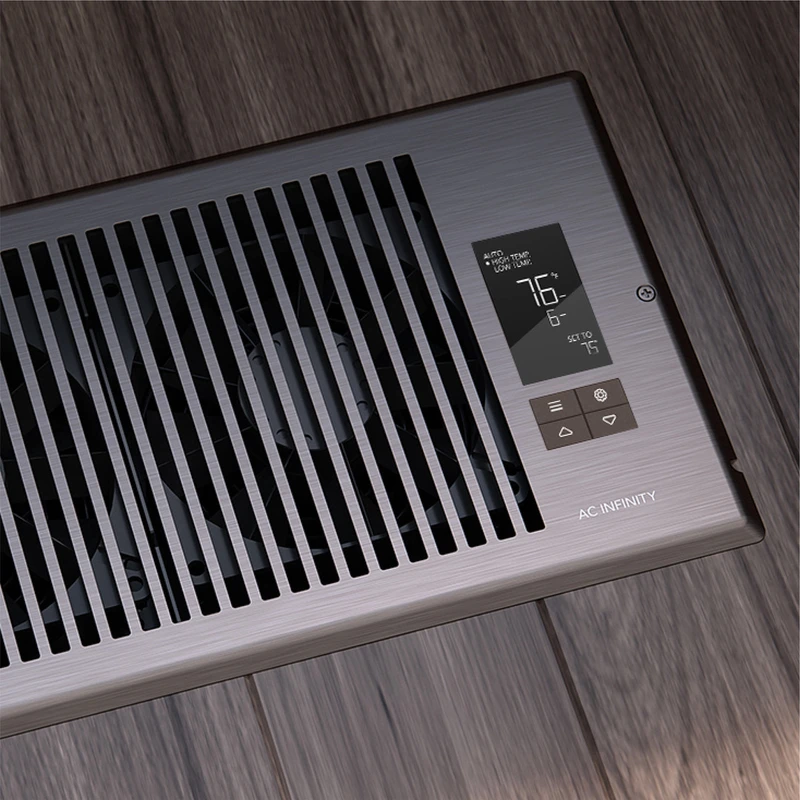
A bedroom that remains warm in summer or cold in winter may not be receiving enough conditioned air from the central HVAC system. Installing a register booster fan can help increase air movement through a weak supply vent, particularly when the room is far from the air handler or served by a long duct run. However, the device should support a reasonably functioning HVAC system rather than conceal a serious duct, insulation, or equipment problem.
What Does a Register Booster Fan Do?
A register booster fan replaces or sits over an existing floor or wall register. Its built-in fans draw additional conditioned air from the supply duct and distribute it into the room.
Many models include temperature-based controls that switch the fan on when heated or cooled air reaches the register. Others provide adjustable speeds or manual operating modes. Because the unit works at the delivery point, it can be installed without opening walls or modifying a major section of ductwork.
These fans are most useful for localized comfort problems. They do not increase the heating or cooling capacity of the central system, nor can they repair crushed ducts, heavy leakage, or mechanical failure.
Why Does One Room Receive Less Airflow?
Air takes the path of least resistance through a duct system. Rooms near the air handler may receive stronger airflow, while distant rooms may receive less. Several other conditions can contribute to the difference:
- Long or undersized branch ducts
- Numerous bends in the duct route
- Partially closed dampers
- Dirty air filters
- Blocked or closed registers
- Leaking or disconnected ducts
- Poor return-air pathways
- Furniture covering the supply opening
- Changes made during renovations
- Improperly balanced ductwork
Solar exposure, exterior walls, window quality, and insulation levels can also make a room feel uncomfortable even when supply airflow is acceptable. Identifying the cause helps determine whether a booster fan is an appropriate response.
What Should You Check Before Installation?
Begin with basic HVAC maintenance. Inspect the central filter and replace it if it is dirty. Confirm that supply and return openings are unobstructed, then make sure dampers and register louvers are open.
Compare the weak register with those in nearby rooms. A noticeably smaller amount of airflow may indicate duct resistance, leakage, or an obstruction. Accessible duct sections should be checked for loose connections, damage, and poor sealing.
Homeowners should avoid closing many registers in other rooms to force air toward the problem area. This can increase pressure in the duct system, reduce equipment performance, and contribute to leakage. HVAC contractors can measure system static pressure and airflow when the cause is not apparent.
Where Are Booster Fans Most Useful?
A register-mounted fan may help in a finished attic, converted bonus room, upper-floor bedroom, home office, or addition located at the end of a duct branch. It can also assist rooms where modest airflow differences create noticeable temperature changes.
The device works best when conditioned air already reaches the vent but needs help entering and circulating through the space. If no air is present when the HVAC system runs, the problem is more likely related to a closed damper, disconnected duct, blockage, or system design fault.
How Do You Choose the Correct Model?
Measure the existing register opening rather than estimating from the outer grille dimensions. The selected product must match the duct opening and intended mounting position.
Other factors to consider include:
- Floor or wall compatibility
- Available fan-speed settings
- Heating and cooling detection
- Noise rating
- Power-cord placement
- Control accessibility
- Grille strength and finish
- Cleaning requirements
Bedrooms and offices may require greater attention to operating sound. Adjustable speed settings allow occupants to balance airflow improvement against fan noise.
How Should the Fan Be Used?
Follow the manufacturer’s placement, electrical, and operating instructions. Keep curtains, rugs, furniture, and other materials away from the intake and discharge areas. The fan needs clear space to pull air from the duct and distribute it across the room.
Temperature-controlled operation is helpful because the fan can run with the heating or cooling cycle instead of operating continuously. Users may need to adjust the activation setting or fan speed as seasons change.
After installation, compare room temperatures over several HVAC cycles. Comfort changes provide more useful information than judging performance after only a few minutes.
When Is Professional HVAC Service Needed?
A booster fan should not be treated as a repair for a failing system. Contact an HVAC professional if the property has widespread airflow problems, unusual duct noise, frozen cooling coils, frequent equipment cycling, rising energy use, or large temperature differences across several rooms.
A contractor may recommend duct sealing, damper adjustments, return-air changes, insulation work, equipment service, or formal air balancing. These measures address the source of the problem when a register-mounted device alone is insufficient.
For a single room with a working supply vent and a moderate comfort difference, a booster fan can be a practical addition. Careful inspection, correct sizing, and suitable controls are essential for getting the desired result. Visit Suncourts to explore airflow products for residential comfort projects and choose a suitable option for your register setup.
