
CPR Certification Online: What You Get, How Long It Lasts, and What It Proves
Completing a course is the visible part of the process, but most of the practical questions arrive afterward. People finish a CPR certification online and then wonder what the card actually establishes, whether an employer can confirm it, how long before it lapses, and whether they would genuinely remember the sequence eighteen months from now. Those questions deserve better answers than they usually get, because the honest ones change how you should treat the certificate.
What the certificate establishes
A CPR certificate records that you completed a defined curriculum from a specific provider on a specific date. It is a training record, not a license, and it does not authorize you to do anything you could not do beforehand. Good Samaritan protections in most jurisdictions cover reasonable assistance from bystanders regardless of training status.
What certification changes is competence and hesitation. Trained responders start faster, compress deeper, and stop less often, and those three variables drive survival more than anything else a bystander controls.
The certificate belongs to you rather than your employer, even when the employer paid. It stays with you across job changes for its full term.
How employers verify it
Most providers issue a certificate carrying your name, the course completed, the completion date, the expiry date, and a unique identifier. Many support online lookup against that identifier, which is how an employer or licensing body confirms it without contacting you.
Two things are worth checking at purchase. First, whether the certificate is verifiable, since a PDF with no verification path is difficult for an employer to accept. Second, whether the provider names the guidelines the course follows. Reputable programs build on ILCOR consensus and the recommendations of the relevant national body, and they say so.
If a specific employer or regulator is the reason you are certifying, confirm the exact credential they accept before enrolling. Requirements vary by profession and jurisdiction, and some settings require an in-person skills assessment that online study supports but does not replace.
How long it lasts
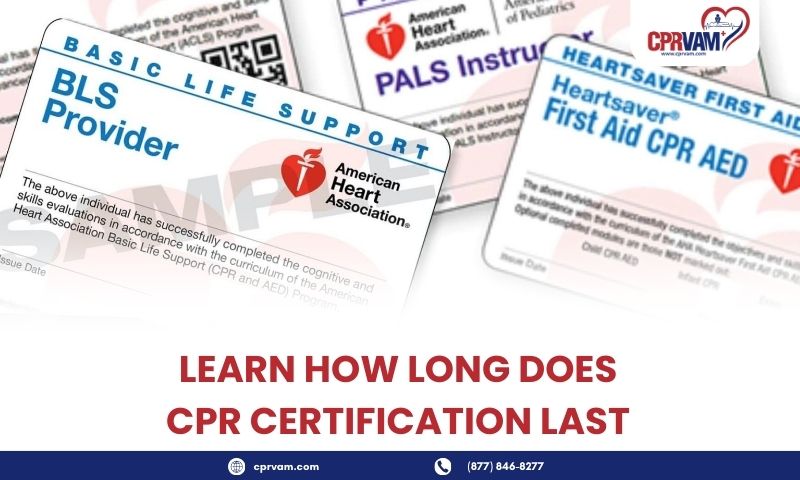
Two years is standard in most of the United States. Three years is common in Canada. Your certificate carries the date, and there is generally no grace period once it passes.
Renewal is usually shorter than initial certification, and the sensible time to book is a month or two before expiry rather than after, since lapsing sometimes forces the full course again.
The gap nobody mentions
Here is the part providers rarely volunteer. Certification terms are administrative conventions. They do not describe how long your skills last.
Research on resuscitation skill retention consistently shows measurable decline within three to six months of training and substantial decline within a year. Compression depth drifts shallow. The sequence gets fuzzy. Confidence about when to start erodes. This is ordinary human memory behavior for a complex motor sequence performed once and never repeated, and it happens to clinicians as reliably as it happens to everyone else.
The implication is not that certification is pointless. It is that a valid card and current competence are different things, and only one of them helps at the moment it matters.
The practical response costs very little. Revisit the compression sequence and the choking response once or twice between renewals. Watch a refresher. Talk through the steps aloud. Practice compression rhythm against a familiar 100-to-120-beat song. Any rehearsal beats none, and the goal is simply that recall arrives without deliberation.
Choosing a provider
Look for current guidelines, a verifiable certificate, a stated expiry, honest course length, and clarity about where the credential is accepted.
The programs at Simple CPR are self-paced and organized by certification level, so you can match the course to your actual situation and complete it around a working schedule. Certification is worth having. Certification you have rehearsed recently is worth considerably more.
